What’s a Christian? (Part 3)

20121127-210508.jpg

This is part three of the series, how many parts there will be I don’t know. But, it’s fun just to continue to write though I’m confident the subject will never be exhausted.

My desire is to find, Scripturally, what a Christ follower is and what one isn’t. I’m positive that I’m growing in my understanding that what we in the American Christian culture call Christianity, in ways, does not measure up to what Jesus would call it. So, I continue my pursuit to find out what Jesus wants me to be, in Him.

I preached a sermon last Sunday from the book of Ephesians, and the text in chapter 4 brought me to what I think is a pretty major conclusion. (My text was Ephesians 4:17-24)

The point that jumps out at me the most is when Paul writes to, “put on the new self” in verse 24. This after a lot of language explaining that our old life, old thoughts, old drives and old wisdom are worthless for the pursuit of this new life in Christ. Worse than that, the old life is actually a major rub, a stark contrast, against the new, Spiritual life.

Here’s the problem. Widely in Christianity, and I think in my own life too, we’ve reduced our faith in Christ to learning a set of principles and trying to apply or live up to them.

Please know this truth. Jesus cannot be reduced down to a set of rules to follow or reduced down to some kind of philosophical salve that’s used as a momentary relief to the pain of life. He’s much more than that! Christianity that defines itself as a new principle to learn and then to apply which continues like the instructions on the back of the shampoo bottle; lather, rinse and repeat, is a painful substitute for real faith and a true relationship with Christ.

So what is Paul’s “put on the new life?” He speaks of this “putting on” also in Romans “But put on the Lord Jesus Christ, and make no provision for the flesh, to gratify its desires.” (Romans 13:14)

Paul’s statement isn’t that we would have Jesus as a proverbial monkey on our back but that we’d have the connection to Him that He desires. In my estimation, Paul’s “put on Jesus” is equivalent to Jesus’ “I am the Vine, you are the branches.” (See John 15:1-5) The key to this new life is not leaning and applying new principles, it’s simply about abiding in the Vine; in Jesus. That is the very thing Jesus said we must do. He never said, “learn and apply principles from my word,” He said, “Abide in me!”

What is a Christian?

A Christian is not someone who is trying learn something about Jesus that my help out in this life, though learning Jesus’ principles certainly do. A Christian is a person who is learning Jesus and learning by the Word and by His Spirit how to truly, fully abide in Him.
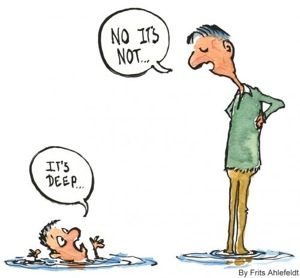
Perspective is everything?

20121123-111048.jpg

I often think about how perspective can make such a difference in attitude. We tend to be more driven and have more perseverance in our work when we believe things are going well. Often in life we evaluate how things are going based upon our perspective. I certainly understand how this works. But, how much should perspective control our attitude?

I’ve always been intrigued by the story of Ezra after the foundation of the new temple is completed and the different reaction between the young men and the old. It’s all based on their perspective. The young men shout with excitement because there will soon be a temple again. They’ve only heard about the former temple that was destroyed when their parents were hauled away to Babylon. The old men as children, however, saw the glorious temple of Solomon and were convinced the new temple could never live up to the glory of the old one.

The book of Ezra explains the confusion of sound as some cheered and other wailed at the sight of the new temple foundation:

And all the people shouted with a great shout when they praised the Lord, because the foundation of the house of the Lord was laid. 12 But many of the priests and Levites and heads of fathers’ houses, old men who had seen the first house, wept with a loud voice when they saw the foundation of this house being laid, though many shouted aloud for joy, 13 so that the people could not distinguish the sound of the joyful shout from the sound of the people’s weeping, for the people shouted with a great shout, and the sound was heard far away.” (Ezra 11b – 13)

Have you ever experienced anything like this in life? I sure have. I’ve been in meetings with ministry leaders in which we looked at the same decision or situation, some view it with optimism and others with trepidation. The difference based solely upon perspective.

The question is; how much of our perspective really plays a part in God’s plan?

There’s an answer to this question, I believe, when Paul’s makes this monumental statement in his letter to the Philippians:

“…for I have learned in whatever situation I am to be content.” (Philippians 4:11)

The truth is; God’s plan is not limited or perpetuated by man’s perspective. God’s perspective is different, greater and more clear than ours every will be in this life. He is great, powerful and is working out His plan according to His perfect will. The good news is, how I feel about it doesn’t make any difference as to whether God will do what He’s set out to do.

I think this truth comes to fruition in Paul’s quotable statement that followed the verse above; “I can do all things through Christ who strengthens me.”

I believe God wants us to have an optimistic perspective simply because we can trust Him in His work. As that work involves us, we work with confidence that He will complete what He’s set out to do. But, even if we’re experiencing struggle, we know, our perspective will not hinder the work of God. Just as the men of Jerusalem, both young and old, saw the completion of the temple, we will see the completion of God’s work too.

What’s a Christian? (Part 2)

This is part two of a blog series in which I intend to investigate, biblically, the marks of a Christian. I want to encourage you to join the conversation in the comments area at the bottom of each post.

The reason I want to take some time with this discussion is simply because I’m a pastor in the Bible Belt which is a culture in which the definition of a Christian is very confused. So may believe that a Christian is simply a person who goes to church or a person raised by people who go to church. (Christians do, and should, go to church but church attendance and worship is a fruit, not a cause.)

I was inspired by some thoughts as I read Oswald Chambers’, My Utmost for His Highest, this morning which led me to make a second defining statement. Here’s what He spoke:

“It is possible to take the forgiveness of sin, the gift of the Holy Ghost, and our sanctification with the simplicity of faith, and to forget at what enormous cost to God it was all made ours.”

This statement caused my mind to go to Philippians 2:5-10 immediately. The cost of God’s ability to forgive us was extremely high. No greater example of Jesus’ sacrifice can be found than Paul’s words, “And being found in human form, he humbled himself by becoming obedient to the point of death, even death on a cross.” What sacrifice! God’s holiness, righteousness and justice made it so He could not forgive us for our sin and sinful nature. But, God’s inexpressible love made it so He would take the punishment for our sin on Himself so He could forgive us. Can you imagine begin the perfect, creating God of the universe and placing yourself in the kind of pain, embarrassment and death that Jesus did? Your answer to that question is actually the same as mine; no, none of us can. No one, who sees forgiveness in the light of Philippians 2:8 views it with a the flippant attitude of the modern American church.

Here, then, is my second definition of a Christian:

A Christian is one who understands that forgiveness is easy to accept but it only comes in light of the inexpressible tragedy of the cross.

Forgiveness is easy to accept but it was not easy to bring about. Though Jesus is the God of the universe, I don’t know of any way to make Philippians 2:5-10 easy for Him and I’m sure we should not make it too easy either. As I like to say when I preach, no one truly sees Jesus for who He is and walks away like He’s no big deal. The same is true for forgiveness. It’s a very big deal!

Yet another reminder of something of which I should be so thankful! What a great God  is He who came after us!

Thankful for….

If you’re like me, you’re thinking a little bit about Thanksgiving by now. In only a couple days you’ll probably be with family, gathered around the table and celebrating with your normal Thanksgiving family traditions. We have our family traditions too.

It’s also a tradition, and certainly a good one, for Christians to think about that for which their thankful to God and count as blessings from Him over the last year. I have much for which to be thankful this year too but I think I’m going to break tradition.

I’m not going to thank God for anything He’s given me this year.

Ok, that’s a little tongue in cheek, not to mention the fact that I’ve been thanking Him all year long for His blessings but, this Thanksgiving, I’m just going to express my thanks for Him. That is, I’m just going to tell Him I’m thankful for Him. This is why:

God Himself is better than anything He’s ever blessed me with!

I don’t want to think about my thanksgiving to God in hopes He gives me more stuff or more health or more years or more anything of this world. I want my thanksgiving to lead me to more of Him. I think that’s the sentiment of the Psalmist who penned Psalm 50.

“The one who offers thanksgiving as his sacrifice glorifies me;
to one who orders his way rightly I will show the salvation of God!” (Psalm 50:23)

Read More

What’s a Christian? (Part 1)

I’m going to write a blog series entitled “What is a Christian?” I almost titled it “What is a Christ follower” but I don’t want to confuse the topic. The truth is, there are a lot of ideas of what a Christian is in our culture, even in the church culture, and many of them are not biblical. I also realize there is no shortage of books, blogs and articles discussing this topic but I think another topical discussion may be helpful. I’m preaching a series now through the book of Ephesians and, along with that, a mini-series of the church called “Full Church.” Within the series, each week, I’m making statements about the church: “Church is…”

So, I want to spend some time on the blog making the same type of statements: A Christian is… I would state it like I have in the church series but it would really sound like Forrest Gump, “Christian is as Christian does, sir.”

But what comes to mind when I ask you, what is a Christian?

For me the answer begins with; a person who follows Jesus. But, what does that look like? I’m confident that what some believe defines being a Christ-follower falls short of what Jesus actually says it is. For example, a Christ follower is not someone who calls on Jesus simply when they need something. It’s much more than that. If you confess to being a Christian I probably don’t have to convince you of that but let’s dig a little deeper into the Christian.

Where do we start?

I can think of no place better to begin than Jesus putting Pharisees and Sadducees in their place. It’s always a little fun to see the religiously educated try to play a game of theological tennis with the creator of the universe. In Matthew 16:1 the Pharisees and Sadducees want Jesus to give them a cosmic sign from heaven to prove His Messiahship. (Keep in mind that at this point of the Gospel of Mathew, Jesus has nothing left to prove.)

We can actually learn something about being a Christian in the way Jesus answers their request.

Jesus tells them that though they have no trouble telling the weather, “Red sky at night shepherds delight, red sky in the morning shepherds take warning,” they can’t see what’s going on right in front of them. That’s what Jesus means when He says, “You can’t interpret the signs of times.”

Wouldn’t it be crazy to be so concerned about “God stuff” like the Pharisees are and miss what Jesus was doing right in front of you?

This can happen in the life of the modern day Christian too. I see it most when Christians define Christianity simply as where they’re going when they die. Now, I’m not stating that heaven is a bad thing to be looking for but that is not the definition of a Christian. It would be a tragedy to be simply focused on heaven, or the future, and not realize what Christ is doing in the world and in your life right now.

What’s a Christian?

A Christian is a person who can recognize that God, through Christ and His Spirit, is doing a work in front of us, in the world and in us, right now.